Estratégias de manejo e impacto do peso ao nascimento na cura de umbigo de leitões neonatos
DOI:
https://doi.org/10.5380/avs.v31i1.102209Palavras-chave:
Hernia, Pre-Weaning, Sus scrofa domesticus, Swine, Umbilical OutpouchingsResumo
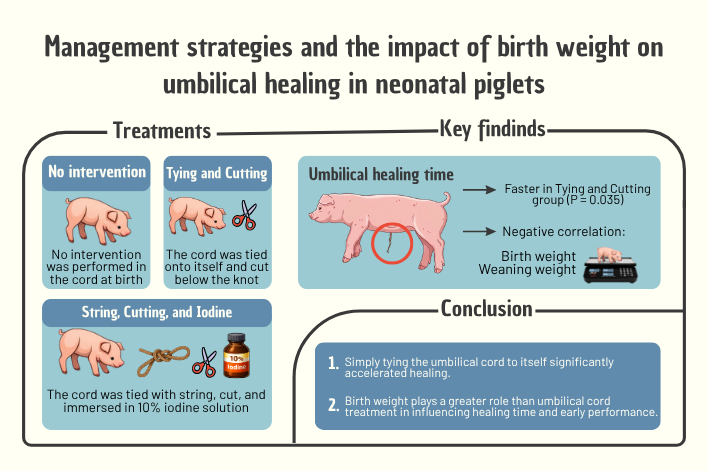
Este estudo avaliou os efeitos de diferentes técnicas de manejo do cordão umbilical em leitões recém-nascidos. Um total de 212 leitões de 15 matrizes foi distribuído em um delineamento em blocos ao acaso. Os tratamentos incluíram: Sem Intervenção (NI) – nenhuma intervenção foi realizada no cordão ao nascimento; Amarração e Corte (TC) – o cordão foi amarrado sobre si mesmo e cortado abaixo do nó; e Barbante, Corte e Iodo (SCI) – o cordão foi amarrado com barbante, cortado e imerso em solução de iodo a 10%. As seguintes variáveis foram analisadas: ingestão de colostro, incidência de hemorragia, tempo de cicatrização, incidência de hérnias umbilicais, performance e viabilidade econômica. Não foram encontrados efeitos dos tratamentos sobre ingestão de colostro, desempenho, incidência de hemorragia ou ocorrência de hérnia umbilical. Leitões do grupo TC apresentaram um tempo de cicatrização ligeiramente menor do que aqueles dos grupos NI e SCI (P = 0.035). Os pesos ao nascimento e ao desmame foram negativamente correlacionados com o tempo de cicatrização — leitões mais leves apresentaram cicatrização mais lenta, enquanto leitões com cicatrização mais rápida alcançaram maiores pesos ao desmame. Em conclusão, cuidados umbilicais adicionais, como aplicação de iodo, não melhoraram a cicatrização umbilical nem o desempenho. Nas condições deste estudo, procedimentos adicionais como o uso de iodo não apresentaram benefícios extras em comparação com uma técnica simples de amarração.
Referências
Arpi, LMB. Histology of the umbilical cord in mammals. In: Histology [Internet], 2019. Available in: http://dx.doi.org/10.5772/intechopen.80766. Access in: 7 jul. 2025.
Blirup-Plum SA, Jensen HE, Hartmann KT, et al. Can infectious omphalitis in piglets be clinically diagnosed during the first three days of life? BMC Vet Res, v. 21, p. 58, 2025. https://doi.org/10.1186/s12917-025-04507-3
Cabrera RA, Lin X, Campbell JM, et al. Influence of birth order, birth weight, colostrum and serum immunoglobulin G on neonatal piglet survival. J Anim Sci Biotechnol, v. 3, n. 1, p. 42, 2012. https://doi.org/10.1186/2049-1891-3-42
Davidov I, Stevančević O, Božić A, et al. Performance comparisons across pig farms. Biotechnol Anim Husb, v. 40, n. 2, p. 131–140, 2024. https://doi.org/10.2298/BAH2402131D
Devillers N, Dividich JL, Prunier A. Influence of colostrum intake on piglet survival and immunity. Animal, v. 5, n. 10, p. 1605–1612, 2011. https://doi.org/10.1017/S175173111100067X
Farmer C, Edwards SA. Review: Improving the performance of neonatal piglets. Animal, v. 16, n. 2, p. 100350, 2022. https://doi.org/10.1016/j.animal.2021.100350
Ferrari CV, Sbardella PE, Bernardi ML, et al. Effect of birth weight and colostrum intake on mortality and performance of piglets after cross-fostering in sows of different parities. Prev Vet Med, v. 114, n. 3–4, p. 259–266, 2014 https://doi.org/10.1016/j.prevetmed.2014.02.013
Hansen ML, Larsen I, Jensen TB, et al. Prevention of umbilical outpouchings and mortality in pigs. Porcine Health Manag, v. 10, p. 10, 2024. https://doi.org/10.1186/s40813-024-00358-w
Hovmand-Hansen T, Jensen TB, Vestergaard K, et al. Early risk factors, development, disappearance and contents of umbilical outpouching in Danish pigs. Livest Sci, v. 251, p. 104654, 2021a. https://doi.org/10.1016/j.livsci.2021.104654
Hovmand-Hansen T, Nielsen SS, Jensen TB, et al. Survival of pigs with different characteristics of umbilical outpouching in a prospective cohort study of Danish pigs. Prev Vet Med, v. 191, p. 105343, 2021b. https://doi.org/10.1016/j.prevetmed.2021.105343
Juthamanee P, Tummaruk P. Factors associated with colostrum consumption in neonatal piglets. Livestock Science, v. 251, p. 104630, 2021. https://doi.org/10.1016/j.livsci.2021.104630
Kumar N, Thakur R, Harini KR, et al. Care and management of piglets. In: Commercial pig farming. p. 173–184, 2025.
https://doi.org/10.1016/B978-0-443-23769-0.00011-7
Kwon CH, Safaie ES, Torres JA, et al. Effects of pigs’ weaning weight on growth performance and blood immunological, antioxidant, and gut permeability parameters in early nursery period. Animals, v. 15, n. 8, p. 1119, 2025. https://doi.org/10.3390/ani15081119
Martin YH, Lali FV, Metcalfe AD. Modelling wound healing. In: MS Ågren, editor. Wound healing biomaterials. Cambridge: Elsevier, 1: 151–73, 2016. https://doi.org/10.1016/B978-1-78242-455-0.00006-9
Matheson SM, Walling GA, Edwards SA. Genetic selection against intrauterine growth retardation in piglets: a problem at the piglet level with a solution at the sow level. Genet. Sel. Evol., v. 50, p. 46, 2018. https://doi.org/10.1186/s12711-018-0417-7
Milligan B, Fraser D, Kramer D. The effect of littermate weight on survival, weight gain, and suckling behavior of low-birth-weight piglets in cross-fostered litters. J of Swine Health Prod, v. 9, n. 4, p. 161–166, 2001. http://dx.doi.org/10.54846/jshap/302
Nowacka-Woszuk J. The genetic background of hernia in pigs: A review. Livest Sci, v. 244, p. 104317, 2021. https://doi.org/10.1016/j.livsci.2020.104317
Nuntapaitoon M, Muns R, Theil PK, et al. Factors influencing colostrum consumption by piglets and their relationship with survival and growth in tropical climates. Livest Sci, v. 224, p. 31–39, 2019. https://doi.org/10.1016/j.livsci.2019.04.008
Pinheiro JM, Ferraz RHS, Ribeiro M, et al. Fetal external features and morphology of the umbilical cord of wild boars. Anat Histol Embryol, v. 53, n. 3, p. e13041, 2024. https://doi.org/10.1111/ahe.13041
Quesnel H, Resmond R, Merlot E, et al. Physiological traits of newborn piglets associated with colostrum intake, neonatal survival and preweaning growth. Animal, v. 17, n. 6, p. 100843, 2023. https://doi.org/10.1016/j.animal.2023.100843
Robinson AL, Colpoys JD, Robinson GD, et al. The effect of antiseptic compounds on umbilical cord healing in piglets in a commercial facility. J of Swine Health Prod, v. 24, n. 4, p. 212–215, 2016. https://doi.org/10.54846/jshap/954
Searcy-Bernal R, Gardner IA, Hird, DW. Effects of and factors associated with umbilical hernias in a swine herd. JAVMA, v. 20, n. 204, 1994. https://doi.org/10.2460/javma.1994.204.10.1660
Schokker D, Zhang J, Zhang L, et al. Early-life environmental variation affects intestinal microbiota and immune development in newborn piglets. PLoS One, v. 9, n. 6, p. e100040, 2014. https://doi.org/10.1371/journal.pone.0100040
Straw B, Bates R, May G. Anatomical abnormalities in a group of finishing pigs: prevalence and pig performance. J of Swine Health Prod, v. 17, n. 1, p. 28–31, 2009. http://dx.doi.org/10.54846/jshap/578
Theil PK, Flummer C, Hurley WL, et al. Mechanistic model to predict colostrum intake based on deuterium oxide dilution technique data and impact of gestation and pre-farrowing diets on piglet intake and sow yield of colostrum. J Anim Sci, v. 92, n. 12, p. 5507–5519, 2014. https://doi.org/10.2527/jas.2014-7841
Yun J, Olkkola S, Hänninen ML, et al. The effects of amoxicillin treatment of newborn piglets on the prevalence of hernias and abscesses, growth and ampicillin resistance of intestinal coliform bacteria in weaned pigs. PLoS One, v. 12, n. 2, p. e0172150, 2017. https://doi.org/10.1371/journal.pone.0172150
Zheng L, Duarte ME, Loftus AS, et al. Intestinal health of pigs upon weaning: Challenges and nutritional intervention. Front Vet Sci, v. 8, p. 628258, 2021. https://doi.org/10.3389/fvets.2021.628258
Publicado
Como Citar
Edição
Seção
Licença

Este trabalho está licenciado sob uma licença Creative Commons Attribution-ShareAlike 4.0 International License.
Autores que publicam nesta revista concordam com os seguintes termos:
- Autores mantém os direitos autorais e concedem à revista o direito de primeira publicação, com o trabalho simultaneamente licenciado sob a Creative Commons - Atribuição 4.0 Internacional que permite o compartilhamento do trabalho com reconhecimento da autoria e publicação inicial nesta revista.
- Autores têm autorização para assumir contratos adicionais separadamente, para distribuição não-exclusiva da versão do trabalho publicada nesta revista (ex.: publicar em repositório institucional ou como capítulo de livro), com reconhecimento de autoria e publicação inicial nesta revista.
- Autores têm permissão e são estimulados a publicar e distribuir seu trabalho online (ex.: em repositórios institucionais ou na sua página pessoal) a qualquer ponto antes ou durante o processo editorial, já que isso pode gerar alterações produtivas, bem como aumentar o impacto e a citação do trabalho publicado.