Quantitative analyses of polyphenol extracts from inflorescences of Musa x paradisiaca against free-living stages of Haemonchus contortus
DOI:
https://doi.org/10.5380/avs.v31i2.101782Keywords:
Phytotherapy, Biofriendly products, principal components, gastrointestinal parasites, in vitro assaysAbstract
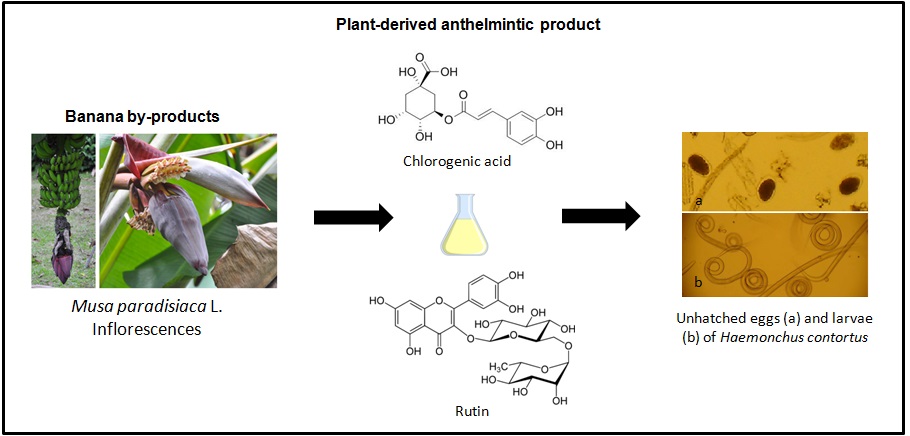
Extracts from Musa x paradisiaca inflorescences were chemically characterized and tested in vitro on ruminant parasite egg hatch (EHT) and larval migration (LMT) tests. The aqueous (EHW-I) and hydroalcoholic (EOH-I) extracts of the plant were analyzed by using colorimetric assays, high-performance liquid chromatography (HPLC), and electrospray tandem mass spectrometry (ESI-MS/MS). EHW-I and EOH-I had similar phenolic contents. However, EOH-I had a higher flavonoid content than EHW-I. Both extracts presented low contents of condensed tannins. HPLC analysis showed that EHW-I contained phenolic acids (chlorogenic acid ˃ coumaric acid > ferulic acid), other than rutin (glycosylated flavonoid). EOH-I contained rutin as the predominant compound. EHW-I and EOH-I showed an inhibitory effect on EHT, reaching almost 100% at a concentration of 1000 µg/mL. The inhibitory concentration of 50% (IC50) of egg hatching was 62.58 and 137.79 µg/mL of EHW-I and EOH-I, respectively. Based on the quantification data of phenolic and flavonoid compounds in the extracts, chlorogenic acid and rutin were selected for the EHT. Chlorogenic acid presented high activity, with an IC50 of 17.55 µg/mL. Rutin, however, did not affect egg hatching under the conditions tested. It can be inferred that chlorogenic acid may be a candidate with ovicidal activity. EHW-I and EOH-I did not affect the migration of third-stage nematode larvae, which may be related to the low tannin content. The inflorescences of Musa x paradisiaca can be further explored to develop a plant-derived anthelmintic product for ruminants and other animals.
References
Adedapo AA, Shabi OO, Adedokun AO. Anthelmintic efficacy of the aqueous crude extract of Euphorbia hirta Linn in Nigerian dogs. Veterinarski Arhiv, 75(1):39-47, 2005. DOI: 10.2298/VETARH0501039A
Amornlerdpison D, Choommongkol V, Narkprasom K, Yimyam S. Bioactive compounds and antioxidant properties of banana inflorescence in a beverage for maternal breastfeeding. Applied Sciences, 11 (1):343, 2021. DOI: 10.3390/app11010343
Athanasiadou S, Githiori J, Kyriazakis I. Medicinal plants for helminth parasite control: facts and fiction. Animal, 1(9):1392-1400, 2007. DOI: 10.1017/S1751731107000730.
Bashkar S, Beegum S, Anandh R, Prakash M. Characterization of banana (Musa sp.‘Elakki bale’) flower and pseudostem by-products by HPLC analysis. Journal of Food Science and Technology, 49 (1): 60–66, 2012.
Bennett RN, Shiga TM, Hassimotto NMA, Rosa EAS, Lajolo FM, Cordenunsi BR. Phenolics and antioxidant properties of fruit pulp and cell wall fractions of postharvest banana (Musa acuminata Juss.) cultivars. Journal of Agricultural and Food Chemistry, 58(13):7991-8003, 2010. DOI: 10.1021/jf1008692
Bizimenyera ES, Githiori JB, Eloff JN, Swan GE. In vitro activity of Peltophorum africanum Sond. (Fabaceae) extracts on the egg hatching and larval development of the parasitic nematode Trichostrongylus colubriformis. Veterinary Parasitology, 142:336-343, 2006. DOI: 10.1016/j.vetpar.2006.06.013
Bovo F, Messias-Reason IJ, Maurer JBB, Zawadzki-Baggio SF, Perez E, Andreazza IF. Extracts or fractions of inflorescences or products of Musa paradisiaca L., the use of the extracts or fractions of inflorescences or products of Musa paradisiaca L., and formulations with extracts and fractions of inflorescences or products of Musa paradisiaca L. Patent registered in Núcleo de Inovação Tecnológica do Paraná (NITPAR) by Federal University of Paraná, process number BR1020130305871, deposit date: 28 nov. 2013, Paraná, Brazil.
Bradford MM. A rapid and sensitive method for the quantitation of microgram quantities of protein utilizing the principle of protein–dye binding. Analytical Biochemistry, 72:248-254, 1976. DOI: 10.1016/0003-2697(76)90527-3
Campos KFD, Monteiro ALG, Molento MB, Batista R, Neves ACC, Debortoli EC, Twardowski TS, Kormann RR. Efficacy of different anthelmintics on the control of gastrointestinal parasites of sheep. Proceedings of the 54th Annual Meeting of the Brazilian Society of Animal Science, p. 1034, 2017.
Chishti G, et al. In vitro anthelmintic efficacy of plant extracts from Leucaena leucocephala, Moringa oleifera and Acacia ampliceps against developmental stages of Haemonchus contortus. Veterinary Parasitology, 330:110185, 2024. DOI: 10.1016/j.vetpar.2024.110185
Coles GC, Bauer C, Borgsteede FHM, Geerts S, Klei TR, Taylor MA, Waller PJ. World Association for the Advancement of Veterinary Parasitology (WAAVP) – methods for detection of anthelmintic resistance in nematodes of veterinary importance. Veterinary Parasitology, 44:35-44, 1992. https://doi.org/10.1016/0304-4017(92)90141-U
Crozier A, Rio DD, Clifford MN. Bioavailability of dietary flavonoids and phenolic compounds. Molecular Aspects of Medicine, 31:446-467, 2010. DOI: 10.1016/j.mam.2010.09.007
Davuluri T, et al. In vitro anthelmintic activity of plant extracts against different stages of Haemonchus contortus. Journal of Parasitic Diseases, 44:512-520, 2020. DOI: 10.1007/s12639-020-01220-5
Demeler J, Küttler U, El-Abdellati A, Stafford K, Rydzik A, Varady M, Kenyon F, Coles G, Höglund J, Jackson F, Vercruysse J, Von Samson-Himmelsterna G. Standardization of the larval migration inhibition test for the detection of resistance to ivermectin in gastrointestinal nematodes of ruminants. Veterinary Parasitology, 174:58-64, 2010. DOI: 10.1016/j.vetpar.2010.08.020
Díaz GJ, Hernández GT, Zamilpa A, Pérez CMB, Bribiesca ER, Mendo OH, Arroyo HS, Cortazar MG, Gives PM. In vitro assessment of Argemone mexicana, Taraxacum officinale, Ruta chalepensis, and Tagetes filifolia against Haemonchus contortus nematode eggs and infective (L3) larvae. Microbial Pathogenesis, 109:162-168, 2017. DOI: 10.1016/j.micpath.2017.05.048
Dutta PK, Das AK, Banerji NA. Tetracyclic triterpenoid from Musa paradisiaca. Phytochemistry, 22:2563-2564, 1983.
Fortes FS, Molento MB. Anthelmintic resistance in gastrointestinal nematodes of small ruminants: advances and limitations for diagnosis. Pesquisa Veterinária Brasileira, 33(12):1391-1402, 2013. https://doi.org/10.1590/S0100-736X2013001200001
Gaudin E, Simon M, Quijada J, Schelcher F, Sutra J, Lespine A, Hoste H. Efficacy of sainfoin (Onobrychis viciifolia) pellets against multi-resistant Haemonchus contortus and interaction with oral ivermectin: implications for on-farm control. Veterinary Parasitology, 227:122-129, 2016. DOI: 10.1016/j.vetpar.2016.08.002
Gayathry G, et al. Application of microencapsulation for valorization of banana (Musa × paradisiaca) pseudostem and inflorescence extracts. Food Production, Processing and Nutrition, 6:74, 2024. DOI: 10.1186/s43014-024-00251-7
Gordon HM, Whitlock HV. A new technique for counting nematode eggs in sheep faeces. Journal of the Council for Scientific and Industrial Research, 12:50–52, 1939.
Horai H, Arita M, Kanaya S et al. MassBank: A public repository for sharing mass spectral data for life sciences. Journal of Mass Spectrometry, 45:703-714, 2010. DOI: 10.1002/jms.1777
Hoste H, et al. Tannin-containing legumes as a model for nutraceuticals against digestive parasites in livestock. Veterinary Parasitology, 212:5-17, 2015. DOI: 10.1016/j.vetpar.2015.06.026
Jaleel AK, Jacob S, Ghosh SM, Suresh A. A comprehensive review on nutrient profile and pharmacological benefits of Musa paradisiaca. Sciences of Phytochemistry, 3 (2):123–143, 2024. DOI: 10.58920/sciphy0302254
Jong TT, Lee MR, Chiang YC, Chiang ST. Using LC/MS/MS to determine matrine, oxymatrine, ferulic acid, mangiferin, and glycyrrhizin in the Chinese medicinal preparations. Journal of Pharmaceutical and Biomedical Analysis, 40:472-477, 2006. DOI: 10.1016/j.jpba.2005.07.036
Kakimori MTA, Debiage RR, Gonçalves FMF, et al. Anthelmintic and antioxidant potential of banana bracts (Musa paradisiaca) extract in ruminants. Acta Veterinaria Brasilica, 13(1):11-18, 2019. DOI: https://doi.org/10.21708/avb.2019.13.1.7917
Kumarasingha R, et al. Anthelmintic activity of selected ethno–medicinal plant extracts on parasitic stages of Haemonchus contortus. Parasites & Vectors, 9:187, 2016. DOI 10.1186/s13071-016-1458-9
Laing R, Gillan V, Devaney E. Ivermectin – old drug, new tricks? Trends in Parasitology, 33(6):463-472, 2017. DOI: 10.1016/j.pt.2017.02.004.
Loganayaki N, Rajendrakumaran D, Manian S. Antioxidant capacity and phenolic content of different solvent extracts from banana (Musa paradisiaca) and mustai (Rivea hypocrateriformis). Food Science and Biotechnology, 19:1251-1258, 2010. DOI 10.1007/s10068-010-0179-7
Mahmood A, Ngah N, Omar MN. Phytochemical constituents and antioxidant activities in Musa x paradisiaca flower. European Journal of Scientific Research, 66(2):311-318, 2011.
Marie-Magdeleine C, Udino L, Philibert L, Bocage B, Archimede H. In vitro effects of Musa x paradisiaca extracts on four developmental stages of Haemonchus contortus. Research in Veterinary Science, 96:127-132, 2014. DOI: 10.1016/j.rvsc.2013.12.004
Molan AL, Waghorn GC, McNabb WC. Effect of condensed tannins on egg hatching and larval development of Trichostrongylus colubriformis in vitro. Veterinary Record, 150:65-69, 2002. DOI: 10.1136/vr.150.3.65
Molento MB, Prichard RK. Effect of multidrug resistance modulators on the activity of ivermectin and moxidectin against selected strains of Haemonchus contortus infective larvae. Pesquisa Veterinária Brasileira, 21(3):117-121, 2001. https://doi.org/10.1590/S0100-736X2001000300004
Molento MB. Parasite control in the age of drug resistance. Veterinary Parasitology, 163:229-234, 2009. DOI: 10.1016/j.vetpar.2009.06.007
Molento MB, Chaaban A, Gomes EN, et al. Plant extracts used for the control of endo and ectoparasites of livestock: a review of the last 13 years of science. Archives of Veterinary Science, 25:1-27, 2020. DOI: 10.5380/avs.v25i0.70806
Nisha P, Mini S. Flavonoid-rich ethyl acetate fraction of Musa paradisiaca inflorescence down–regulates the streptozotocin-induced oxidative stress, hyperglycaemia, and mRNA levels of selected inflammatory genes in rats. Journal of Functional Foods, 5:1838-1847, 2013. https://doi.org/10.1016/j.jff.2013.09.003
Nogueira FA, et al. Anthelmintic efficacy of banana crop residues on gastrointestinal nematodes of sheep: in vitro and in vivo tests. Parasitology Research, 111(1):317-323, 2012. DOI: 10.1007/s00436-012-2842-9
Padam BS, Tin HS, Chye FY, Abdullah MI. Antibacterial and antioxidative activities of the various solvent extracts of banana (Musa paradisiaca cv. Mysore) inflorescences. Journal of Biological Sciences, 12(2):62-73, 2012. DOI: 10.3923/jbs.2012.62.73
Pavei C, Kaiser S, Borré GL, Ortega GG. Validation of an LC method for polyphenols assay in cat’s claw (Uncaria tomentosa). Journal of Liquid Chromatography & Related Technologies, 33:1551-1561, 2010. DOI:10.1080/10826076.2010.503753
Pavela R, Benelli G. Essential oils as eco–friendly biopesticides? Challenges and constraints. Trends in Plant Science, 21(12):1000-1007, 2016. DOI: 10.1016/j.tplants.2016.10.005
Pazmiño-Durán EA, Giusti MM, Wrolstad RE, Glória MBA. Anthocyanins from banana bracts (Musa x paradisiaca) as potential food colorants. Food Chemistry, 73:327-332, 2001. DOI:10.1016/S0308-8146(00)00305-8
Queiroz CRAA, Morais SAL, Nascimento EA. Caracterização dos taninos da aroeira-preta. Scientia Forestalis, 26(4):485-492, 2002. https://doi.org/10.1590/S0100-67622002000400011
Ramírez-Bolaños E et al. Phytochemical characterization of banana (Musa sp.) flower and pseudostem as novel food ingredients. International Journal of Food Science and Technology, 56:5601–5608, 2021. DOI: 10.1111/ijfs.15072
Rogers WP, Brooks F. The mechanism of hatching of eggs of Haemonchus contortus. International Journal for Parasitology, 7:61-65, 1977. https://doi.org/10.1016/0020-7519(77)90026-1
Rojas-Morales D, et al. Anthelmintic activity of plant extracts inhibiting egg hatching and larval exsheathment of Haemonchus contortus. Veterinary Parasitology, 296:109473, 2021. DOI: 10.1016/j.vetpar.2021.109473
Senevirathna R et al. Banana inflorescence as a new source of bioactive and pharmacological ingredients for the food industry. Food Chemistry Advances, 5:100814, 2024. DOI: 10.1016/j.focha.2024.100814
Shodehinde SA, Oboh G. Antioxidant properties of aqueous extracts of unripe Musa paradisiaca on sodium nitroprusside induced lipid peroxidation in rat pancreas in vitro. Asian Pacific Journal of Tropical Biomedicine, 3(6):449-457, 2013. DOI: 10.1016/S2221-1691(13)60095-7
Singhal M, Ratra P. Antioxidant activity, total flavonoid and total phenolic content of Musa acuminata peel extracts. Global Journal of Pharmacology, 7(2):118-122, 2013. DOI: 10.5829/idosi.gjp.2013.7.2.72158
Singleton VL, Rossi JA. Colorimetry of total phenolics with phosphomolybdic–phosphotungstic acid reagents. American Journal of Enology and Viticulture, 16(3):144-158, 1965. DOI: 10.5344/ajev.1965.16.3.144
Tajik N, Tajik M, Mack I, Enck P. The potential effects of chlorogenic acid, the main phenolic components in coffee, on health: a comprehensive review of the literature. European Journal of Nutrition, 56(7):2215-2244, 2017. DOI: 10.1007/s00394-017-1379-1
Vennat B, Gross D, Pourrat A, Pourrat H. Hamamelis virginiana: identification and assay of proanthocyanidins, phenolic acids and flavonoids in leaf extracts. Pharmazie Acta Helvetiae, 67(1):11-14, 1992.
Yang J, Guo J, Yuan J. In vitro antioxidant properties of rutin. LWT – Food Science and Technology, 41:1060-1066, 2008. https://doi.org/10.1016/j.lwt.2007.06.010
Downloads
Published
How to Cite
Issue
Section
License

This work is licensed under a Creative Commons Attribution-ShareAlike 4.0 International License.
Authors that wish to publish in AVS agree with the following conditions:
- To keep copyright of the article and allow the AVS to publish the first time. The article will be licensed by Creative Commons - Atribuição 4.0 Internacional allowing the sharing of their work.
- Authors may distribute their work by other channel of distribution (ex.: local or public repository).
- Authors have the permission to publish their work online, using different channels (similar to above), even before the final editorial process.