Topical Use of Injectable Dexmedetomidine in Combination with Dorzolamide for the Treatment of Glaucoma in Dogs
DOI:
https://doi.org/10.5380/avs.v30i4.99797Keywords:
intraocular pressure, pharmacological repositioning, ophthalmology, alpha-2 agonistAbstract
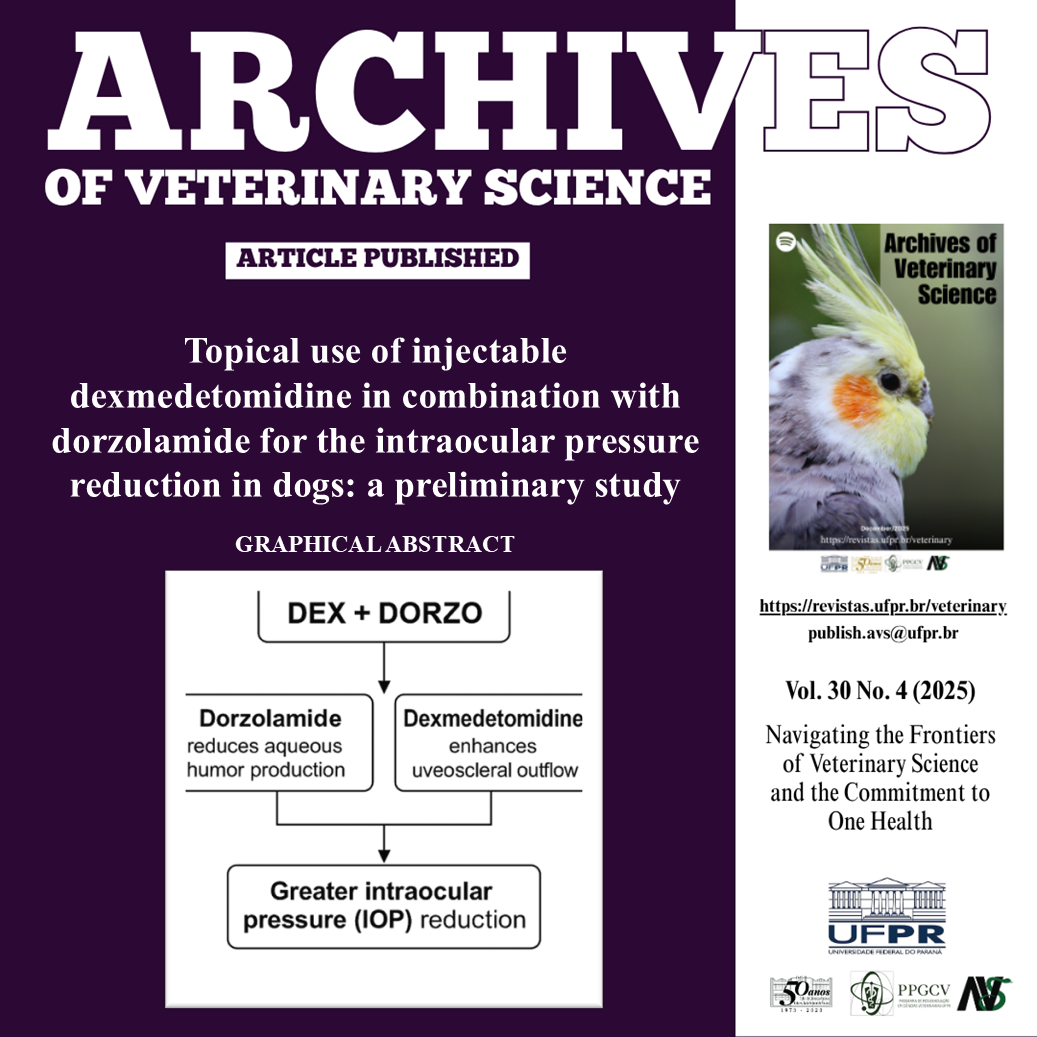
This study investigated the efficacy of the isolated topical use of 2% dorzolamide eye drops three times a day compared to the combination of 100 µg/ml dexmedetomidine (originally formulated for injectable use and applied topically twice a day) associated with the use of 2% dorzolamide eye drops three times a day, in reducing intraocular pressure (IOP) in dogs diagnosed with glaucoma. A total of 29 dogs with glaucoma and IOP greater than 25 mmHg were selected based on specific clinical criteria of the disease. The dogs were divided into two groups: Group 1 (DORZO) included 12 animals that received only 2% dorzolamide eye drops every eight hours, and Group 2 (DEX DORZO) included 17 animals that received 2% dorzolamide eye drops every eight hours combined with 100 µg/ml dexmedetomidine applied topically every 12 hours. IOP measurements were taken on the day of the first clinical evaluation and again at 7 and 30 days after the glaucoma diagnosis. Vital parameters such as heart rate, respiratory rate, and systolic blood pressure were assessed before and 30 minutes after the topical application of dexmedetomidine. The results showed a significant reduction in IOP in eyes treated with dorzolamide alone (DORZO) and those treated with the combination of dexmedetomidine and dorzolamide (DEX DORZO). The DEX DORZO group had an average reduction of 35.99% (p = 0.001) in IOP at the end of the 30-day evaluation compared to a 20.32% reduction in the DORZO group (p = 0.6026). There were no statistically significant differences in the evaluated vital parameters, and no cases of blepharospasm or hyperemia were observed following medication administration in either group. In conclusion, the topical administration of dexmedetomidine twice daily, combined with dorzolamide eye drops, may be an effective and safe approach to reducing IOP in dogs with glaucoma. These results suggest the potential use of dexmedetomidine as an additional therapeutic option for the treatment of glaucoma in dogs, due to its alpha-2 adrenergic agonist action and the absence of significant adverse effects.
References
Abdelhamid AM, Mahmoud AAA, Abdelhaq MM, et al. Dexmedetomidine as an additive to local anesthetics compared with intravenous dexmedetomidine in peribulbar block for cataract surgery. Saudi Journal of Anesthesia, 10(1);50-54, 2016.
Alm A, Nilsson SFE. Uveoscleral outflow – A review. Experimental Eye Research. 88(4);760-768, 2009.
Arthur S, Cantor LB. Update on the Role of Alpha-Agonists in Glaucoma Management. Experimental Eye Research, 93;271-283, 2011.
Artigas C, Redondo JI, López-Murcia M. Effects of intravenous administration of dexmedetomidine on intraocular pressure and pupil size in clinically normal dogs. Veterinary Ophthalmology, 15(1);79-82, 2012
Banga PK, Singh DK, Dadu S, et al. A comparative evaluation of the effect of intravenous dexmedetomidine and clonidine on intraocular pressure after suxamethonium and intubation. Saudi Journal of Anesthesia, 9(2);179-183, 2015.
Bencurova DM, Vyborny P, Dankova P. Comparative analysis of tear cytokines in patients with glaucoma, ocular hypertension, and healthy controls. International Ophthalmology, 43:3559-3568, 2023.
Brioschi FA, Gioeni D, Jacchetti A, et al. Effect of metoclopramide on nausea and emesis in dogs premedicated with morphine and dexmedetomidine. Veterinary Anaesthesia and Analgesia, 45(2);190-194, 2018.
Cantor LB. Brimonidine in the treatment of glaucoma and ocular hypertension. Therapeutics and Clinical Risk Management, 2(4):337-343, 2006.
Cawrse MA, Ward DA, Hendrix DVH. Effects of topical application of a 2% solution of dorzolamide on intraocular pressure and aqueous humor flow rate in clinically normal dogs. American Journal of Veterinary Research, 62(6);859-863, 2001.
Chrysostomou C, Schmitt CG. Dexmedetomidine: sedation, analgesia and beyond. Expert Opinion on Drug Metabolism & Toxicology, 4;619-627, 2008.
Cohen J. Statistical power analysis for the behavioral sciences (2nd ed.). Lawrence Erlbaum Associates, 1988.
Fakhoury H, Abdelmassih Y, El-Khoury S, et al. Effect of Topical Dexmedetomidine (0.0055%) on Intraocular Pressure in Healthy Eyes: A Randomized Controlled Trial. Journal of Current Glaucoma Practice, 15(2);58-63, 2021.
Flammer J, Mozaffarieh M. What Is the Present Pathogenetic Concept of Glaucomatous Optic Neuropathy? Survey of Ophthalmology, 52, Suppl. 2; S162-S173, 2007.
Gelatt KN, MacKay E.O. Effect of different dose schedules of latanoprost on intraocular pressure and pupil size in the glaucomatous Beagle. Veterinary Ophthalmology, 4(4);283–288, 2001.
Gelatt KN, MacKay EO. Effect of single and multiple doses of 0.2% brimonidine tartrate in the glaucomatous Beagle. Veterinary Ophthalmology, 5(4);253-262, 2002.
Gelatt KN, Mackay EO. Prevalence of the breed-related glaucomas in pure-bred dogs in North America. Veterinary Ophthalmology, 7(2);97-111, 2004.
Gertler R, Brown C, Mitchell DH, et al. Dexmedetomidine: a novel sedative-analgesic agent. Baylor University Medical Center Proceedings, 14;13-21, 2001.
Goel M, Picciani RG, Lee RK, et al. Aqueous humor dynamics: a review. The open ophthalmology journal, 4;52-59, 2010.
Holló G. The side effects of the prostaglandin analogues. Expert Opinion on Drug Safety, 6(1);45–52, 2007
Honjo M, Inatani M, Kido N, et al. Effects of protein kinase inhibitor, HA1077, on intraocular pressure and outflow facility in rabbit eyes. Archives of Ophthalmology, 119(8);1171–1178, 2001.
Honjo M, Tanihara H, Inoue T, et al. Rho-kinase inhibitors as emerging targets for glaucoma therapy. Ophthalmology, 122(8); 1830-1838, 2015.
Ingram CJ, Brubaker RF. Effect of brinzolamide and dorzolamide on aqueous humor flow in human eyes. American Journal of Ophthalmology, 128(3);292–296, 1999.
Jaakola ML, Melkkila TA, Kanto J, et al. Dexmedetomidine reduces intraocular pressure, intubation responses, and anaesthetic requirements in patients undergoing ophthalmic surgery. British Journal of Anaesthesia, 68;570-575, 1992.
Jayanetti V, Sandhu S, Lusthaus JA. The Latest Drugs in Development That Reduce Intraocular Pressure in Ocular Hypertension and Glaucoma. Journal of Experimental Pharmacology, 12;539-548, 2020.
Kim Y, Lee H, Park J, et al. HL3501, a novel selective A3 adenosine receptor antagonist, lowers intraocular pressure in animal glaucoma models. Investigative Ophthalmology & Visual Science, 63(13); 5731-5742, 2022.
Komáromy AM, Bras D, Esson DW, et al. The future of canine glaucoma therapy. Veterinary Ophthalmology, 22(5);726-740, 2019.
Komnenou AA, Mylonakis ME, Kouti V, et al. Ocular manifestations of natural Canine Monocytic Ehrlichiosis (Ehrlichia canis): a retrospective study of 90 cases. Veterinary Ophthalmology, 10(3);137-142, 2007.
Leiva M, Naranjo C, Peña MT. Ocular signs of Canine Monocytic Ehrlichiosis: A retrospective study in dogs from Barcelona, Spain. Veterinary Ophthalmology, 8(6); 387-393, 2005.
Li G, Zhang L, Wu X, et al. Trabodenoson, an adenosine mimetic with A₁ receptor selectivity, lowers intraocular pressure by increasing conventional outflow facility in mice. Investigative Ophthalmology & Visual Science, 59(1); 383-392, 2018.
MacDonald E, Vartiainen J, Jasberg K. Systemic absorption and systemic effects of ocularly administered dexmedetomidine in rabbits. Current Eye Research, 12(5);451-460, 1993.
Maggio F, Bras D. Surgical treatment of canine glaucoma: Filtering and End-Stage Glaucoma Procedures. Veterinary Clinics of North America: Small Animal Practice, 45;1261-1282, 2015.
Mattos-Junior E, Pypendop BH, Cabrini TM, et al. Effects of dexmedetomidine alone or in combination with opioids on intraocular pressure in healthy Beagle dogs. Veterinary Anaesthesia na Analgesia, 48(4);541-544, 2021.
Mowafi HA, Aldossary N, Ismail AS, et al. Effect of dexmedetomidine premedication on the intraocular pressure changes after succinylcholine and intubation. British Journal of Anaesthesia, 100(4);485-489, 2008.
Oh DJ, Martin JL, Williams AJ, et al. Analysis of expression of matrix metalloproteinases and tissue inhibitors of metalloproteinases in human ciliary body after latanoprost. Investigative Ophthalmology &Visual Science, 47(3);953–963, 2006.
Pal CK, Ray M, Sen A, et al. Changes in intraocular pressure following administration of suxamethonium and endotracheal intubation: Influence of dexmedetomidine premedication. Indian Journal of Anesthesia, 55(6);573-577, 2011.
Pegu J, Purang AK, Dubery S, et al. Effect of dexmedetomidine on intraocular pressure as an additive in peribulbar block during glaucoma surgery. Indian Journal of Ophthalmology, 69 (6), 612-616, 2020.
Plummer CE, MacKay EO, Gelatt KN. Comparison of the effects of topical administration of a fixed combination of dorzolamide-timolol to monotherapy with timolol or dorzolamide on IOP, pupil size, and heart rate in glaucomatous dogs. Veterinary Ophthalmology, 9(4);245–9, 2006.
Plummer CE, Regnier A, Gelatt KN. The canine glaucomas. In: Gelatt KN, Gilger BC, Kern TJ, eds. Veterinary Ophthalmology, vol 2, 5th edition. Ames, IA: John Wiley Inc;1050-1145, 2013.
Quigley HA, Bowman AT. The number of people with glaucoma worldwide in 2010 and 2020. British Journal of Ophthalmology, 90;262-267, 2006.
Quigley HA, Pitha I, Welsbie DS, et al. Losartan treatment protects retinal ganglion cells and alters scleral remodeling in experimental glaucoma. Investigative Ophthalmology & Visual Science, 56(7); 4149-4161, 2015.
Rao PV, Deng P, Kumar, J, et al. Modulation of aqueous humor outflow facility by the Rho kinase–specific inhibitor Y-27632. Investigative Ophthalmology & Visual Science, 42(5);1029–1037, 2001.
Reitsamer HA, Kiel JW. Relationship between ciliary blood flow and aqueous production in rabbits. Investigative Ophthalmology & Visual Science, 44(9);3967-3971, 2003.
Reitsamer HA, Posey M, Kiel JW. Effects of a topical alpha2 adrenergic agonist on ciliary blood flow and aqueous production in rabbits. Experimental Eye Research, 82(3);405-415, 2005.
Richter M, Krauss AH, Woodward DF, et al. Morphological changes in the anterior eye segment after long-term treatment with different receptor selective prostaglandin agonists and a prostamide. Investigative Ophthalmology and Visual Science, 44(10);4419–26, 2003.
Roy Chowdhury U, Brackett D, Hong H, et al. Pharmacological profile and ocular hypotensive effects of Cromakalim Prodrug 1 (CKLP1), a novel ATP-sensitive potassium channel opener, in normotensive dogs and non-human primates. Journal of Ocular Pharmacology and Therapeutics, 37(5);251-260, 2021.
Roy Chowdhury U, Brackett D, Hong H, et al. Effect of ATP-sensitive potassium channel openers on intraocular pressure in ocular hypertensive animal models. Investigative Ophthalmology & Visual Science, 63(2);15, 2022.
Sambhara D, Aref AA. Glaucoma management: relative value and place in therapy of available drug treatments. Therapeutic Advances in Chronic Disease, 5(1);30–43, 2014.
Senthil S, Burugupally K, Rout U, et al. Effect of Intravenous Dexmedetomidine on Intraocular Pressure in Patients Undergoing Glaucoma Surgery Under Local Anesthesia: A Pilot Study. Journal of Glaucoma, 29(10);846-850, 2020.
Sinclair MD. A review of the physiological effects of alpha2-agonists related to the clinical use of medetomidine in small practice. The Canadian Veterinary Journal, 44(11);885-897, 2003.
Skaat, A, Rosman, MS, Chien JL. Effect of pilocarpine hydrochloride on the Schlemm canal in healthy eyes and eyes with open-angle glaucoma. Journal of the American Medical Association Ophthalmology, 134(9);976–981, 2016.
Stamer WD, Piwnica D, Jolas T, et al. Cellular basis for bimatoprost effects on human conventional outflow. Investigative Ophthalmology & Visual Science, 51(10);5176–5181, 2010.
Studer ME, Martin CL, Stiles J. Effects of 0.005% latanoprost solution on intraocular pressure in healthy dogs and cats. American Journal of Veterinary Research, 61(10);1220–1224, 2000.
Sugrue MF. The preclinical pharmacology of dorzolamide hydrochloride, a topical carbonic anhydrase inhibitor. Journal of Ocular Pharmacology and Therapeutics, 12(3);363-376, 1996.
Sugrue MF. Pharmacological and ocular hypotensive properties of topical carbonic anhydrase inhibitors. Progress in Retinal and Eye Research, 19(1);87-112, 2000.
Tanna AP, Johnson MR. Rho kinase inhibitors as a novel treatment for glaucoma and ocular hypertension. Ophthalmology, 125(11);1741–1756, 2018.
Tham YC, Li X, Wong TY, et al. Global Prevalence of glaucoma and projections of glaucoma burden through 2040. Ophthalmology, 121(11);2081-2090, 2014.
Vartiainen J, MacDonald E, Urtti A, et al. Dexmedetomidine-Induced Ocular Hypotension in Rabbits with Normal or Elevated Intraocular Pressures. Investigative Ophthalmology & Visual Science, 33(6);2019-2023, 1992.
Villela NR, Nascimento JR P. Uso de dexmedetomidina em anestesiologia. Revista. Brasileira de Anestesiologia, 53;97-113, 2003.
Vohra R, Tsai JC, Kolko M. The role of inflammation in the pathogenesis of glaucoma. Survey of Ophthalmology, 58(4);311-320, 2012.
Waters, H., Johnson, A., Smith, R., et al. Topical trabodenoson is neuroprotective in a rodent model of anterior ischemic optic neuropathy. Translational Vision Science & Technology, 8(6); 47, 2019.
Webb TER. A review of glaucoma surgical therapy. Veterinary Ophthalmology, 24(S1);34-38, 2021.
Weinreb RN, Aung T, Medeiros FA. The Pathophysiology and Treatment of Glaucoma: A Review. Journal of the American Medical Association, 311(18);1901-1911, 2014.
Whelan NC, Welch P, Pace A, et al. A comparison of the efficacy of topical brinzolamide and dorzolamide alone and in combination with oral methazolamide in decreasing normal canine intraocular pressure. 30th Annual Meeting of the American College of Veterinary Ophthalmologists. Chicago (IL), October 1999.
Wilkie DA, Latimer CA. Effects of topical administration of timolol maleate on intraocular pressure and pupil size in dogs. American Journal of Veterinary Research, 52(3);432–435, 1991.
Zimmerman, T.J. Topical ophthalmic beta blockers: a comparative review. Journal of Ocular Pharmacology and Therapeutics, 9(4);373–384, 1993.
Downloads
Published
How to Cite
Issue
Section
License

This work is licensed under a Creative Commons Attribution-ShareAlike 4.0 International License.
Authors that wish to publish in AVS agree with the following conditions:
- To keep copyright of the article and allow the AVS to publish the first time. The article will be licensed by Creative Commons - Atribuição 4.0 Internacional allowing the sharing of their work.
- Authors may distribute their work by other channel of distribution (ex.: local or public repository).
- Authors have the permission to publish their work online, using different channels (similar to above), even before the final editorial process.