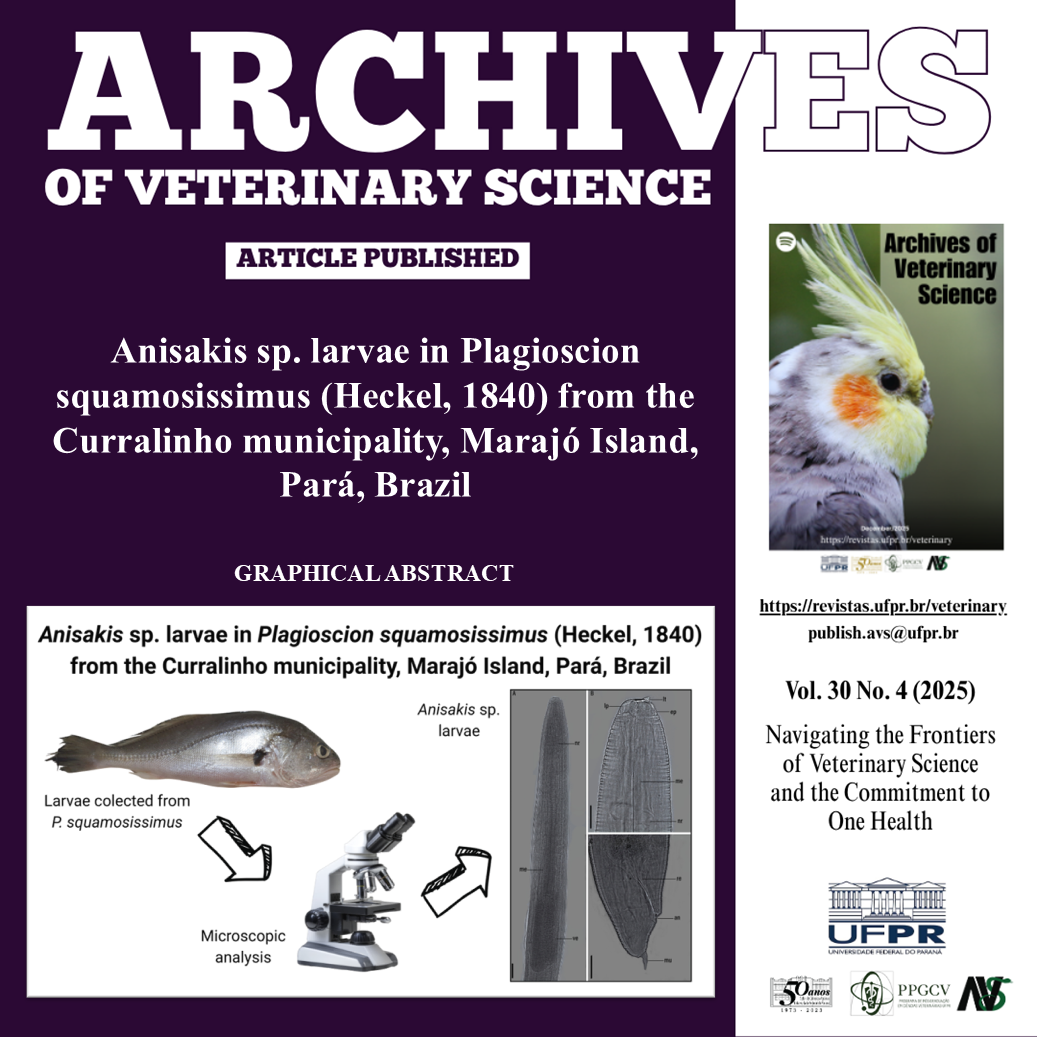
Anisakis sp. larvae in Plagioscion squamosissimus (Heckel, 1840) from the Curralinho municipality, Marajó Island, Pará, Brazil
DOI:
https://doi.org/10.5380/avs.v30i4.98412Keywords:
Anisakidae, Parasite, Fish, AmazonAbstract
Abstract: Several reports from Brazil indicate the presence of fish parasitized by nematodes with zoonotic potential, notably those within the Anisakidae family. This research investigates the morphology, morphometry, and prevalence of Anisakis larvae parasitizing fish being sold in the municipality of Curralinho, in the Brazilian state of Pará. Twenty specimens of Plagioscion squamosissimus were directly collected from the Guajará River by fishers in the city of Curralinho. These fish were purchased, necropsied, and their organs were individually placed in Petri dishes containing saline solution for helminthological examination using a stereomicroscope. All the fish (100%) were found to be parasitized, and a total of 1,390 third-stage Anisakis larvae were recovered, encysted in the intestinal serosa and mesentery. The third-stage larvae were analyzed using light and scanning electron microscopy. Morphologically, the third-stage Anisakis larvae exhibited an anterior end featuring a dorsal lip and two poorly developed ventrolateral lips, a boring tooth, and an excretory pore situated below the boring tooth. Internally, they possessed a muscular esophagus, a long ventriculus, a terminal mucron, and a ventricular appendix, while an intestinal cecum was absent. The presence of these third-stage Anisakis larvae in fish sold in markets underscores their significance for public health, as these Anisakidae nematodes, especially Anisakis spp, are known to cause anisakiasis.
References
Alves AM, Souza GTR, Takemoto RM, Melo CM, Madi RR & Jeraldo VLS. (2019). Anisakidae Skrjabin & Karokhin, 1945 and Raphidascarididae Hartwich, 1954 nematodes in lutjanidae (Pisces: Perciformes) from the Brazilian Northeast Coast. Brazilian Journal of Biology, 80(2), 255-265. https://doi.org/10.1590/1519-6984.190350
Anderson RC. Nematode parasites of vertebrates. Their development and transmission. 2nd ed. London: CABI Publishing; 2000. 650 p. http://dx.doi.org/10.1079/9780851994215.0000
Andrade-Porto SM, Cárdenas MQ, Martins ML, Oliveira JKQ, Pereira JN, Araújo CSO & Malta JC. (2015). First record of larvae of Hysterothylacium (Nematoda: Anisakidae) with zoonotic potential in the pirarucu Arapaima gigas (Osteichthyes: Arapaimidae) from South America. Brazilian Journal of Biology, 75(4), 790-795. http://dx.doi.org/10.1590/1519-6984.22213
Bautista-Hernández CE, Monks S, Pulido-Flores G & Rodríguez-Ibarra AE. Revisión bibliográfica de algunos términos ecológicos usados en parasitología y su aplicación en estudios de caso. In: Pulido-Flores G, Monks S, López-Herrera M, editors. Estudios en biodiversidad [online]. Lincoln: Zea Books; 2015. p. 11-19. [cited 2025 January 10]. Available from: http://digitalcommons.unl.edu/biodiversidad/2
Borges JN, Cunha LFG, Santos HLC, Monteiro-Neto C & Santos CP. (2012). Morphological and molecular diagnosis of anisakid nematode larvae from cutlassfish (Trichiurus lepturus) off the coast of Rio de Janeiro, Brazil. PloS one, 7(7), e40447. https://doi.org/10.1371/journal.pone.0040447
Boujard T, Pascal M, Gallé J, Le Bail PY & Meunier F. (2006). Poissons de Guyane: Guide écologique de l'Approuague et de la réserve des Nouragues. Paris: INRA Éditions, 1997. 219 p. (ISSN 0763 -1707)
Brasil. Classificação de risco dos agentes biológicos [online]. 2. ed. 2010. [cited 2025 January 10]. Available from: http://bvsms.saude.gov.br/bvs/publicacoes/classificacao_risco_agentes_biologicos_2ed.pdf
Bush AO, Lafferty KD, Lotz JM & Shostak AW. (1997). Parasitology meets ecology on its own terms: Margolis et al. revisited. The Journal of Parasitology, 575-583. https://doi.org/10.2307/3284227
Cárdenas MQ, Justo MCN, Viana DC & Cohen SC. (2021). New host record and geographical distribution of Nematoda parasitizing Hypophthalmus marginatus Valenciennes (Siluriformes) from the Tocantins River, Brazil. Acta Scientiarum: Biological Sciences, 43(1). https://doi.org/10.4025/actascibiolsci.v43i1.58014
Cipriani P, Palomba M, Giulietti L, Marcer F, Mazzariol S, Santoro M, et al. (2022). Distribution and genetic diversity of Anisakis spp. in cetaceans from the Northeast Atlantic Ocean and the Mediterranean Sea. Scientific Reports, 12(1): 13664. http://dx.doi.org/10.1038/s41598-022-17710-1
Chero JD, Ñacari L, Cruces CL, López DF, Cacique E, Severino R, et al. (2023). Morphological and molecular characterization of Anisakid nematode larvae (Nematoda: Anisakidae) in the Black Cusk eel Genypterus maculatus from the Southeastern Pacific Ocean off Peru. Diversity (Basel), 15(7): 820. http://dx.doi.org/10.3390/d15070820
Eiras JC, Pavanelli GC, Takemoto RM, Yamaguchi MU, Karkling LC & Nawa Y. (2016). Potential risk of fish-borne nematode infections in humans in Brazil–current status based on a literature review. Food and Waterborne Parasitology, 5, 1-6. https://doi.org/10.1016/j.fawpar.2016.08.002
Felizardo NN, Knoff M, Pinto RM, Gomes DC. (2009). Larval anisakid nematodes of the flounder Paralichthys isosceles Jordan, 1890 (Piscei: Teleostei) from Brazil. Neotrop Helminthol 2009; 3(2): 57-64.
Fonseca MCG, Knoff M, Felizardo NN, Di Azevedo MIN, Torres EJL, Gomes DC, et al. Integrative taxonomy of Anisakidae and Raphidascarididae (Nematoda) in Paralichthys patagonicus and Xystreurys rasile (Pisces: Teleostei) from Brazil. Int J Food Microbiol 2016; 235(17): 113-124. https://doi.org/10.1016/j.ijfoodmicro.2016.07.026
Fontenelle G, Knoff M, Felizardo NN, Lopes LMS & São Clemente SCD. (2013). Nematodes of zoonotic importance in Cynoscion guatucupa (Pisces) in the state of Rio de Janeiro. Revista Brasileira de Parasitologia Veterinária, 22(2), 281-284. https://doi.org/10.1590/s1984-29612013005000019
Fontenelle G, Knoff M, Felizardo NN, Torres EJL, Matos ER, Gomes DC & São Clemente SCD. (2016). Anisakid larva parasitizing Plagioscion squamosissimus in Marajó Bay and Tapajós River, state of Pará, Brazil. Revista Brasileira de Parasitologia Veterinária, 25, 492-496. https://doi.org/10.1590/s1984-29612016034
Froese R. & D. Pauly. Editors. 2024.FishBase. World Wide Web electronic publication. www.fishbase.org. (accessed January 10, 2025)
Giese EG, Santos JN & Lanfredi RM. (2009). A new species of Camallanidae from Ageneiosus ucayalensis (Pisces: Siluriformes) from Pará State, Brazil. Journal of Parasitology, 95, 407-412. https://doi.org/10.1645/ge-1680.1
Giese EG, Furtado AP, Lanfredi RM & Santos JN. (2010). A new cucullanid species (Nematoda) from Ageneiosus ucayalensis Castelnau, 1855 (Pisces: Auchenipteridae) from Pará, Brazil. Journal of Parasitology, 96(2), 389-394. https://doi.org/10.1645/ge-2081.1
Klimpel S, Palm HW. Anisakid Nematode (Ascaridoidea) life cycles and distribution: increasing zoonotic potential in the time of climate change? In: Mehlhorn H, editor. Progress in parasitology: parasitology research monographs. Berlin, Heidelberg: Springer; 2011. vol. 2, p. 201-222. http://dx.doi.org/10.1007/978-3-642-21396-0_11
Kuhn T, Cunze S, Kochmann J, Klimpel S. (2016). Environmental variables and definitive host distribution: a habitat suitability modelling for endohelminth parasites in the marine realm. Scientific Reports, 6(1): 30246. http://dx.doi.org/10.1038/srep30246
Luque JL, Aguiar JC, Vieira FM, Gibson DI & Santos CP. (2011). Checklist of Nematoda associated with the shes of Brazil. Zootaxa, 3082, 1−88. https://doi.org/10.11646/zootaxa.3082.1.1
Mattiucci S, Nascetti G. (2008) Advances and trends in the molecular systematics of anisakid nematodes, with implications for their evolutionary ecology and host-parasite co-evolutionary processes. Advances in Parasitology, 66: 47-148. http://dx.doi.org/10.1016/S0065-308X(08)00202-9
Melo FTDV, Rodrigues RAR, Giese EG, Gardner SL & Santos JND. (2014). Histopathologic aspects in Plagioscion squamosissimus (HECKEL, 1940) induced by Neoechinorhynchus veropesoi, metacestodes and anisakidae juveniles. Revista Brasileira de Parasitologia Veterinária, 23(2), 224-230. https://doi.org/10.1590/S1984-29612014048
Morais AM, Cárdenas MQ & Malta, JCDO. (2019). Nematofauna of red piranha Pygocentrus nattereri (Kner, 1958) (Characiformes: Serrasalmidae) from Amazonia, Brazil. Revista Brasileira de Parasitologia Veterinária, 28, 458-464. https://doi.org/10.1590/S1984-29612019055
Moreira ADC, Oliveira TTDS, Morey GAM & Malta JC. (2017). Metazoários parasitas de Tripotheus angulatus (Spix & Agassiz, 1829) do Lago Catalão, Rio Solimões, Amazonas, Brasil. Folia Amazónica, 26(1), 9-16.
Moravec F. Nematodes of freshwater fishes of the Neotropical Region. Prague: Praha (Czech Republic) Academia; 1998. 464 p. ISBN 978-80-200-0705-6.
Pavanelli GC, Karling LC, Takemoto RM, Ueda BH. Estado da arte dos parasitos de peixes de água doce do Brasil. In: Pavanelli GC, Takemoto RM, Eiras JC, orgs. Parasitologia de peixes de água doce do Brasil. Maringá: Eduem; 2013. p. 11-16
Pinheiro RHS, Furtado AP, Santos J N & Giese E G. (2019). Contracaecum larvae: a morphological and morphometric retrospective analysis, biogeography and zoonotic risk in the Amazon. Revista Brasileira de Parasitologia Veterinária, 28(1): 12-32. https://doi.org/10.1590/S1984-29612019002
Rabelo NLF, Silva TCM, Araújo LRF, Pinheiro, RHS & Rocha CAM. (2017). Detection of Anisakidae larvae parasitizing Plagioscion squamosissimus and Pellona castelnaeana in the State of Pará, Brazil. Acta Scientiarum. Biological Sciences, 39(3), 389-395. https://doi.org/10.4025/actascibiolsci.v39i3.35615
Reis MS, Santos CP, Nunes JLS & Mugnai R. (2021). Checklist of nematodes parasitizing fish in the Brazilian Amazon. Journal of Helminthology, 95, e75. (https://doi.org/10.1017/S0022149X21000729)
Rocha CAM, Pessoa CMF, Rodrigues CAC, Pinheiro RHS, Costa ET, Guimarães AC & Burbano RR. (2016). Investigation into the cytotoxicity and mutagenicity of the Marajó Archipelago waters using Plagioscion squamosissimus (Perciformes: Sciaenidae) as a bioindicator. Ecotoxicology Environmental Safety, 132(10), 111-115. https://doi.org/10.1016/j.ecoenv.2016.05.020
Rodrigues MV, Pantoja JCF, Guimarães CDO, Benigno RNM, Palha MDDC & Biondi GF (2015). Prevalence for nematodes of hygiene-sanitary importance in fish from Colares Island and Vigia, Pará, Brazil. Revista Brasileira de Ciência Veterinária, 22(2). https://doi.org/10.4322/rbcv.2015.364
Safonova AE, Voronova AN, Vainutis KS. (2021). First report on molecular identification of Anisakis simplex in Oncorhynchus nerka from the fish market, with taxonomical issues within Anisakidae. Journal of Nematology, 53(1): e2021-e2023. http://dx.doi.org/10.21307/jofnem-2021-023
Santana HP, Anjos CS, Morais AM & Malta JCO. (2017). Nematode larvae with zoonotic importance found in peacock bass Cichla monoculus (Spix & Agassiz, 1831) from floodplain lakes in Central Amazon. Revista Brasileira de Zoociências, 18(2). https://doi.org/10.34019/2596-3325.2017.v18.24615
Santos CAML. (2017). Doenças parasitárias associadas ao consumo de pescado no Brasil: incidência e epidemiologia. Higiene Alimentar, 31(270/271). [cited 2025 January 10]. Available from: https://docs.bvsalud.org/biblioref/2017/08/848876/270-271-jul-ago-2017-65-71.pdf
Shih HH, Ku CC & Wang CS. (2010). Anisakis simplex (Nematoda: Anisakidae) third-stage larval infections of marine cage cultured cobia, Rachycentron canadum L., in Taiwan. Veterinary Parasitology, 171(3-4), 277-285. https://doi.org/10.1016/j.vetpar.2010.03.023
Souza ME, Cardoso EO, Leal LA, Lima TMP, Toledo RCC. (2016). Anisakidose humana: zoonose com risco potencial para consumidores de pescado cru. Veterinária e Zootecnia; 23(1): 25-37.
Souza, D. C., Eiras, J. C., Adriano, E. A., & Corrêa, L. L. (2020). Metazoan parasites of Plagioscion squamosissimus (Osteichthyes: Sciaenidae) of two rivers from the eastern Amazon (Brazil). Annals of Parasitology, 66(2). (https://doi.org/10.17420/ap6602.257)
Takemoto RM, Lizama MAP. Helminth fauna of fishes from the Upper Paraná River floodplain, Brazil. Neotrop Helminthol 2010; 4(1): 5-8.
Timi JT, Sardella NH & Navone GT. (2001). Parasitic nematodes of Engraulis anchoita Hubbs et Marini, 1935 (Pisces, Engraulidae) of the Argentine and Uruguayan coasts, South West Atlantic. Acta Parasitologica, 46(3), 186-193.
Downloads
Published
How to Cite
Issue
Section
License

This work is licensed under a Creative Commons Attribution-ShareAlike 4.0 International License.
Authors that wish to publish in AVS agree with the following conditions:
- To keep copyright of the article and allow the AVS to publish the first time. The article will be licensed by Creative Commons - Atribuição 4.0 Internacional allowing the sharing of their work.
- Authors may distribute their work by other channel of distribution (ex.: local or public repository).
- Authors have the permission to publish their work online, using different channels (similar to above), even before the final editorial process.