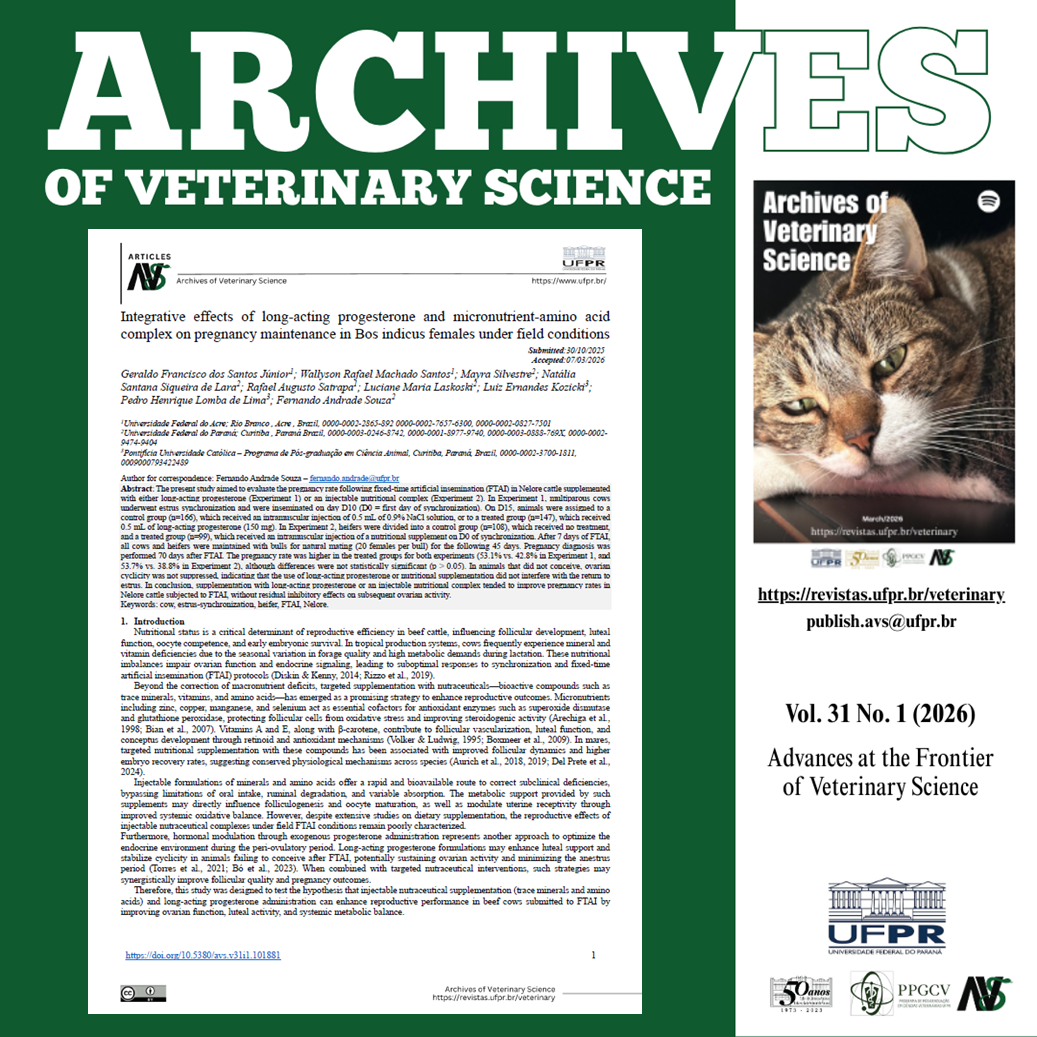
Integrative effects of long-acting progesterone and micronutrient-amino acid complex on pregnancy maintenance in Bos indicus females under field conditions
DOI:
https://doi.org/10.5380/avs.v31i1.101881Keywords:
cow, estrus-synchronization, heifer, FTAI, Nelore.Abstract
The present study aimed to evaluate the pregnancy rate following fixed-time artificial insemination (FTAI) in Nelore cattle supplemented with either long-acting progesterone (Experiment 1) or an injectable nutritional complex (Experiment 2). In Experiment 1, multiparous cows underwent estrus synchronization and were inseminated on day D10 (D0 = first day of synchronization). On D15, animals were assigned to a control group (n = 166), which received an intramuscular injection of 0.5 mL of 0.9% NaCl solution, or to a treated group (n = 147), which received 0.5 mL of long-acting progesterone (150 mg). In Experiment 2, heifers were divided into a control group (n = 108), which received no treatment, and a treated group (n = 99), which received an intramuscular injection of a nutritional supplement on D0 of synchronization. After 7 days of FTAI, all cows and heifers were maintained with bulls for natural mating (20 females per bull) for the following 45 days. Pregnancy diagnosis was performed 70 days after FTAI. The pregnancy rate was higher in the treated groups for both experiments (53.1% vs. 42.8% in Experiment 1, and 53.7% vs. 38.8% in Experiment 2), although differences were not statistically significant (p > 0.05). In animals that did not conceive, ovarian cyclicity was not suppressed, indicating that the use of long-acting progesterone or nutritional supplementation did not interfere with the return to estrus. In conclusion, supplementation with long-acting progesterone or an injectable nutritional complex tended to improve pregnancy rates in Nelore cattle subjected to FTAI, without residual inhibitory effects on subsequent ovarian activity.
References
Arechiga, C. F., Ealy, A. D., Hansen, P. J., & Thatcher, W. W. (1998). Evidence that glutathione protects preimplantation bovine embryos from heat shock by maintaining embryonic viability and reducing oxidative stress. Biology of Reproduction, 59(5), 1409–1416. https://doi.org/10.1095/biolreprod59.5.1409
Aurich, C., Budik, S., & Aurich, J. E. (2018). Nutritional factors and antioxidant status in relation to fertility in horses. Journal of Equine Veterinary Science, 68, 79–85. https://doi.org/10.1016/j.jevs.2018.04.002
Aurich, C., Budik, S., & Aurich, J. E. (2019). Effects of antioxidant supplementation on reproductive performance in mares. Theriogenology, 132, 169–175. https://doi.org/10.1016/j.theriogenology.2019.04.014
Bian, X., Huang, J., Liang, J., Liu, L., & Li, Y. (2007). Zinc, copper and manganese superoxide dismutase activities and mRNA expression in the bovine corpus luteum. Theriogenology, 68(6), 979–985. https://doi.org/10.1016/j.theriogenology.2007.07.001
Bó, G. A., Cutaia, L., Baruselli, P. S., Menchaca, A., & Mapletoft, R. J. (2023). Advances in reproductive management of beef cattle in South America: Synchronization, embryo technologies, and field fertility. Animal Reproduction, 20(2), e20230012. https://doi.org/10.1590/1984-3143-AR2023-0012
Boxmeer, J. C., Macklon, N. S., Lindemans, J., Beckers, N. G. M., Eijkemans, M. J. C., Laven, J. S. E., Steegers, E. A. P., & Steegers-Theunissen, R. P. M. (2009). Antioxidants and the reproductive system: Impact on sperm, oocytes and embryos. Human Reproduction Update, 15(6), 667–682. https://doi.org/10.1093/humupd/dmp025
CBRA – Colégio Brasileiro de Reprodução Animal. (2013). Manual para Exame Andrológico e Avaliação de Sêmen Animal (3rd ed.). Belo Horizonte: CBRA.
Del Prete, C., Di Palo, R., Salzano, A., & Neglia, G. (2024). Effects of antioxidant vitamin supplementation on reproductive performance and oxidative balance in dairy cows and mares. Animals, 14(3), 455. https://doi.org/10.3390/ani14030455
Diskin, M. G., & Kenny, D. A. (2014). Optimising reproductive performance of beef cows and replacement heifers. Animal, 8(S1), 27–39. https://doi.org/10.1017/S175173111400086X
Mann, G. E., & Lamming, G. E. (1999). The influence of progesterone during early pregnancy in cattle. Reproduction in Domestic Animals, 34(3–4), 269–274. https://doi.org/10.1111/j.1439-0531.1999.tb01250.x
Mann, G. E., & Lamming, G. E. (2001). Relationship between maternal endocrine environment, early embryo development and inhibition of the luteolytic mechanism in cows. Reproduction, 121(1), 175–180. https://doi.org/10.1530/rep.0.1210175
Moraes, J. C. F., Hoff de Souza, C. J., Brauner, C. C., Pimentel, M. A., Vieira-Benavides, M., & Sterman-Ferraz, J. B. (2013). Utilização do escore de condição corporal pós-parto na identificação de vacas de corte mais férteis criadas em sistemas extensivos. Archivos Latinoamericanos de Producción Animal, 21(3), 149–155.
Rizzo, A., D’Occhio, M. J., Kaczmarek, M. M., & Williams, S. A. (2019). Nutritional modulation and reproductive efficiency in beef cattle: Impacts on ovarian physiology and endocrine signaling. Animal Reproduction Science, 207, 123–132. https://doi.org/10.1016/j.anireprosci.2019.06.005
Torres, C. A., Pereira, M. H. C., Martins, C. M., & Bó, G. A. (2021). Post-AI progesterone supplementation and fertility in Bos indicus cattle: A meta-analytical perspective. Theriogenology, 170, 1–9. https://doi.org/10.1016/j.theriogenology.2021.04.010
Volker, D., & Ludwig, M. (1995). Role of vitamin A and β-carotene in reproduction. Theriogenology, 43(3), 795–801. https://doi.org/10.1016/0093-691X(94)00022-Y
Downloads
Published
How to Cite
Issue
Section
License

This work is licensed under a Creative Commons Attribution-ShareAlike 4.0 International License.
Authors that wish to publish in AVS agree with the following conditions:
- To keep copyright of the article and allow the AVS to publish the first time. The article will be licensed by Creative Commons - Atribuição 4.0 Internacional allowing the sharing of their work.
- Authors may distribute their work by other channel of distribution (ex.: local or public repository).
- Authors have the permission to publish their work online, using different channels (similar to above), even before the final editorial process.