
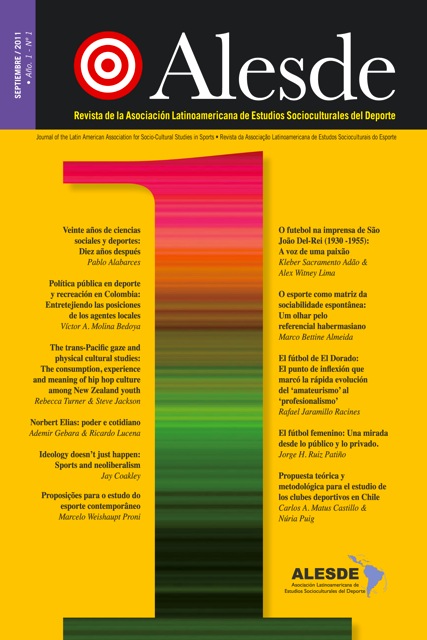
La ideología no ocurre por sí sólo: el deporte y el neoliberalismo
DOI:
https://doi.org/10.5380/alesde.v1i1.22743Resumen
La investigación sobre el deporte en la sociedad se ve desalentada por las creencias existencialistas que lo definen como una expresión fija, innata de los impulsos humanos. Esto ha perjudicado los intereses del deporte como una práctica cultural y como forma de organización social, lo que se utiliza comúnmente para reafirmar los procesos nacionales y mundiales del neoliberalismo. En este artículo se aclara el significado del neoliberalismo contemporáneo y sugiere que el está estrechamente relacionado con la aparición y el apoyo del deporte de élite, organizado, competitivo y comercial. A su vez, estos deportes son a menudo promovidos y representados para establecer, reafirmar y reproducir los ideales y las creencias neoliberales. A pesar de la resistencia, el neoliberalismo continúa ganando aceptación entre las personas alrededor del mundo por la amplia gama de estrategias utilizadas por sus defensores. A pesar de las estrategias más visibles se centraren en las políticas públicas y la economía, el éxito a largo plazo de estas políticas depende de la incorporación de las ideas y las creencias neoliberales en la vida social y cultural. Por lo tanto, la resistencia efectiva y el establecimiento de viables estrategias alternativas requieren una comprensión basadas del cultural y social, así como las manifestaciones económicas y políticas del neoliberalismo. Parte de esa estrategia implica esfuerzos para reclamar las actividades físicas y deportivas como parte de la esfera pública y cambiar las prioridades de financiación para apoyar las actividades más allá de las manifestaciones físicas del deporte de élite, organizado y competitivo. Estrategias para producir estos cambios son identificadas.
Descargas
Publicado
Cómo citar
Número
Sección
Licencia
Los autores que publiquen en esta revista acceden a las siguientes condiciones:
(a) Los autores retienen los derechos de copia (copyright) y ceden a la revista el derecho de primera publicación, con el trabajo asimismo bajo la licencia Creative Commons Attribution License que permite a terceros utilizar lo publicado siempre que hagan referencia al autor o autores del trabajo y a su publicación en esta revista.
(b) Los autores son libres de realizar otros acuerdos contractuales para la distribución no exclusiva del artículo que publiquen en esta revista (como puede ser incluirlo en una colección institucional o publicarlo en un libro), siempre que indiquen claramente la publicación original del trabajo en esta revista.
(c) Se permite y anima a los autores a publicar su trabajo en Internet (por ejemplo en páginas institucionales o personales) en forma de "working paper" o "preprint" después del proceso de revisión y publicación, ya que puede conducir a intercambios productivos y a una mayor y más rápida difusión del trabajo publicado. (Vea The Effect of Open Access).