
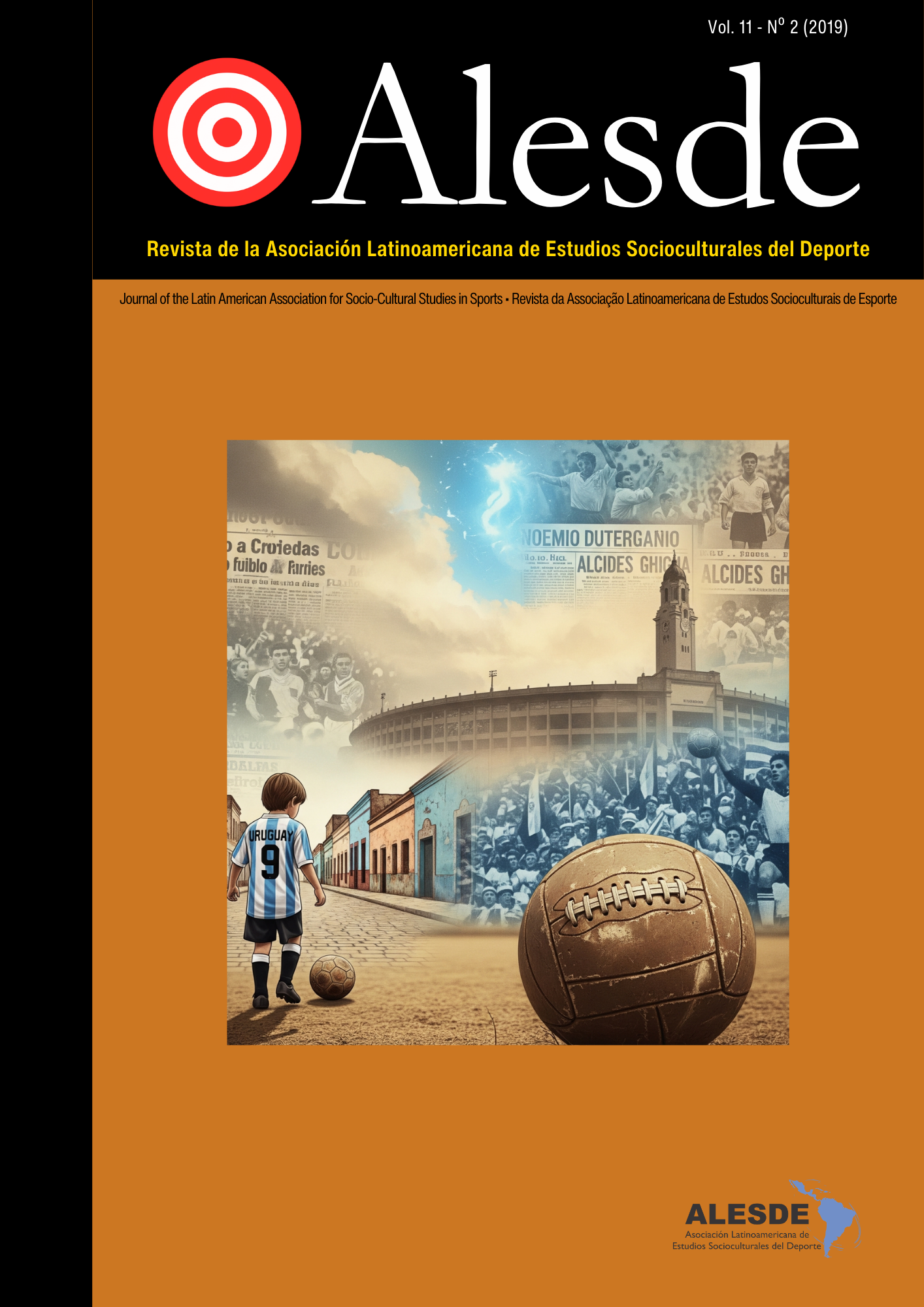
El campo de los estudios socioculturales del deporte en Uruguay
DOI:
https://doi.org/10.5380/jlasss.v11i2.69155Keywords:
Deporte, Sociología, Campo, InvestigaciónAbstract
Este artículo analiza la contribución de la sociología uruguaya al campo de los estudios sociales y culturales sobre el deporte enfocándose en los temas, abordajes y tradiciones de investigación seguidas por los investigadores nacionales. El trabajo comienza presentando las características principales del campo deportivo y los orígenes de la sociología del deporte.* Como primer paso en cualquier disciplina está el construir su objeto de estudio. Establecer cuál será la porción de la realidad de la que se ocupará esa disciplina o sub-disciplina. Siguiendo este enfoque epistemológico, a partir de los trabajos de Brohm (1982), Bourdieu (1986) y Elias-Dunning (1992) se define el objeto de estudio*, los problemas de investigación y los abordajes metodológicos de la sociología del deporte. Posteriormente se presentan los orígenes y características principales de este campo en América Latina y Uruguay.
Downloads
Published
How to Cite
Issue
Section
License
Authors who publish with this journal agree to the following terms:
(a) Authors retain copyright and grant the journal right of first publication with the work simultaneously licensed under a Creative Commons Attribution License that allows others to share the work with an acknowledgement of the work's authorship and initial publication in this journal.
(b) Authors are able to enter into separate, additional contractual arrangements for the non-exclusive distribution of the journal's published version of the work (e.g., post it to an institutional repository or publish it in a book), with an acknowledgement of its initial publication in this journal.
(c) Authors are permitted and encouraged to post their work online (e.g., in institutional repositories or on their website) after the submission process, as it can lead to productive exchanges, as well as earlier and greater citation of published work (See The Effect of Open Access).