
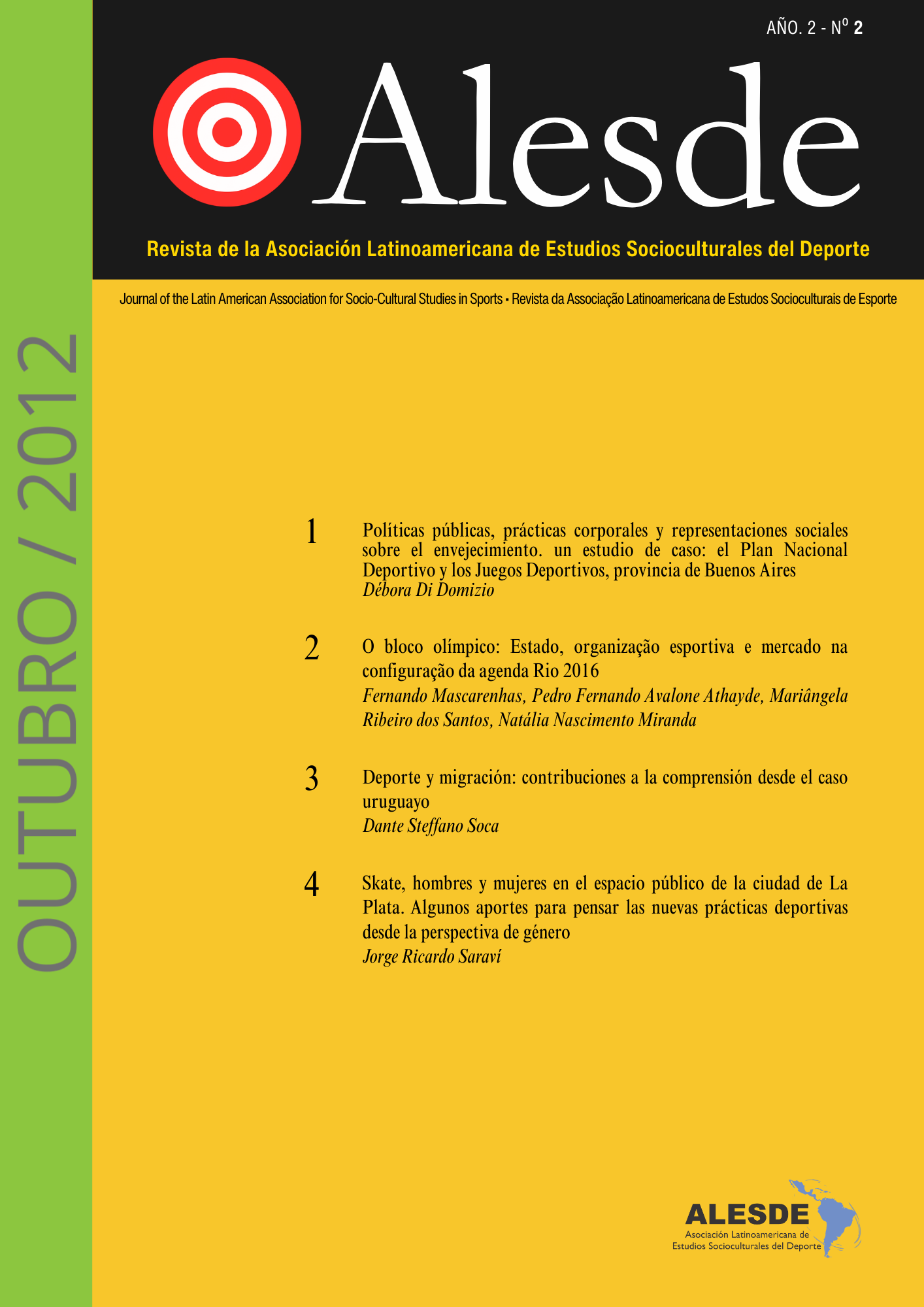
PUBLIC POLICIES, BODY PRACTICES AND SOCIAL REPRESENTATIONS ON AGEING. A CASE STUDY: THE NATIONAL SPORTS PLAN AND THE SPORTS GAMES, BUENOS AIRES PROVINCE
DOI:
https://doi.org/10.5380/alesde.v2i2.30790Keywords:
Social representations, Ageing, Public policyAbstract
In this paper we present the ideas of a number of speeches from which public policies have been designing and implementing that have embodied body practices (related to sport) with seniors and who build a particular social representation of ageing. In these policies, were detected to study social dimensions from which were identified and categorized traits that allowed us to highlight certain aspects for the interpretation and analysis of them. Preliminary progress is linked to a qualitative approach of research that do not pursue knowledge as universal and only closed truth, but to provide a framework for understanding certain features and characteristics of the studied reality. In the speeches of the programs analyzed there is a reductionist view of the body practices in old age, in which is shown to sports and ascetic habits like utilitarian goods for achieving good longevity and also a good channeling, aside subjective and collective meanings that operate in those who are going through these scenarios.
Downloads
How to Cite
Issue
Section
License
Authors who publish with this journal agree to the following terms:
(a) Authors retain copyright and grant the journal right of first publication with the work simultaneously licensed under a Creative Commons Attribution License that allows others to share the work with an acknowledgement of the work's authorship and initial publication in this journal.
(b) Authors are able to enter into separate, additional contractual arrangements for the non-exclusive distribution of the journal's published version of the work (e.g., post it to an institutional repository or publish it in a book), with an acknowledgement of its initial publication in this journal.
(c) Authors are permitted and encouraged to post their work online (e.g., in institutional repositories or on their website) after the submission process, as it can lead to productive exchanges, as well as earlier and greater citation of published work (See The Effect of Open Access).