Critical Review of «The Innovation Delusion»
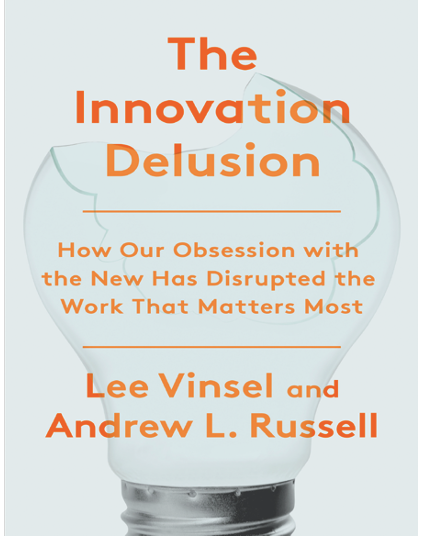
How Our Obsession with the New Has Disrupted the Work That Matters Most (Vinsel & Russell, 2020)
DOI:
https://doi.org/10.5380/nocsi.i7.102433Keywords:
Critical Studies of Innovation, Innovation Speak, Maintenance, Lee Vinsel, Andrew Russell, Innovation Delusion, The Maintainers, United States, Steve Shapin, David Edgerton, Adam Tooze, Alvin TofflerAbstract
The Innovation Delusion: How Our Obsession with the New Has Disrupted the Work That Matters Most (2020), by Lee Vinsel and Andrew L. Russell, presents a blistering critique of the contemporary ideology of innovation, exposing what the authors call «innovation-speak» – a hegemonic discourse that glorifies disruptive change and marginalises the essential work of maintenance.
The Innovation Delusion, by Lee Vinsel and Andrew L. Russell, published not many years ago (2020), is among the scholar books one must read, especially for younger generations and policymakers around the world. Many years ago, Steven Shapin (1989) unearthed the role of the technician in modern science. Innovation Delusion does the same for hidden activities in innovation — i.e., activities related to technology and engineering. Maintenance, upkeep and care is the motto behind Vinsel and Russell’s book.
References
References
Antunes, R. (2018). O privilégio da servidão. O novo proletariado de serviços na era digital. São Paulo: Boitempo.
Hiessl, C., Gonsales, M., Roncato, M. S., van der Laan, M., Antunes, R. coord. (2024). Trabalho em Plataformas: Regulamentação ou Desregulamentação? São Paulo: Boitempo.
Edgerton, D. (2006). The shock of the old: Technology and global history since 1900. Oxford, UK: Oxford University Press.
Godin, B. (2015). Innovation Contested: The Idea of Innovation Over the Centuries. Routledge.
Godin, B. (2017). Models of Innovation: History of an Idea. MIT Press.
Godin, B. (2019). The Invention of Technological Innovation. Languages, Discourses and Ideology in Historical Perspective. Cheltenham, UK: Edward Elgar.
Shapin, S. (1989). The invisible technician. American Scientist, 77(6), 554-563.
Toffler, A. (1970). Future shock. New York, NY: Random House.
Toffler, A. (1980). The third wave. New York, NY: William Morrow and Company.
Tooze, A. (2014). The sense of a vacuum: Wages of destruction and the narrative of Nazi economics. History and Theory, 53(2), 203-215.
Tooze, A. (2018). Crashed: How a decade of financial crises changed the world. New York, NY: Viking.
Tooze, A. (2021). Shutdown: How COVID shook the world's economy. New York, NY: Viking.
Vinsel, L., & Russell, A. L. (2020). The innovation delusion: How our obsession with the new has disrupted the work that matters most. New York, NY: Currency.
Additional Files
Published
How to Cite
Issue
Section
License
Copyright (c) 2025 Tiago Brandão

This work is licensed under a Creative Commons Attribution-NonCommercial-ShareAlike 4.0 International License.
NOvation is an open-access journal under a Creative Commons – CC Attribution-NonCommercial-ShareAlike 4.0 license, which allows others to share the work with an acknowledgement (and preservation) of the author's authorship and intellectual property rights.
To this extent, the authors who publish in this journal agree with the following terms:
1. Authors retain the rights and grant the journal the right of first publication, with the work published under the Creative Commons – CC Attribution-NonCommercial-ShareAlike 4.0 that allows [...].
2. Authors have authorization for distribution, of the version of the work published in this journal, in an institutional repository, thematic, databases and in other works as a book chapter, with acknowledgement of authorship and initial publication in the journal;
3. Papers published in this journal will be indexed in databases, repositories, portals, directories and other sources in which the journal is and will be indexed.
Ethical Responsibilities of Authors
This journal is committed to upholding the integrity of the scientific record.
Consent to submit has been received explicitly from all co-authors, as well as from the responsible authorities – tacitly or explicitly – at the institute/organization where the work has been carried out, before the work is submitted.